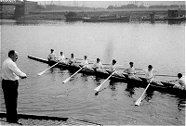
We currently present two overviews of club history. The topmost one entitled Brief Chronology - the first 150 years is taken from the souvenir programme for the club's Sesquicentennial Dinner on 16 December 2002.
The second more discursive one Tyne Amateur Rowing Club in its 112th year was prepared in 1960. Apologies if you want something more recent, but it's on the way. This web site is of course chronicling things as they happen now, but dates only from mid 2009.
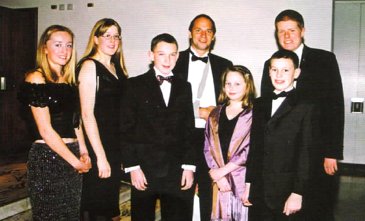
1852 16th December - Tyne Amateur Rowing Club founded.
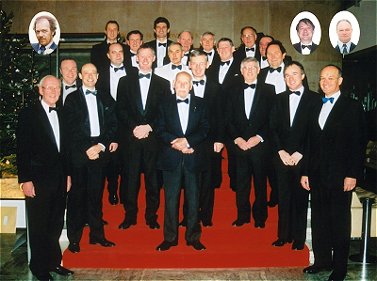
________________________________________________________________________________________________
IN ITS 112TH YEAR
"A meeting of Gentlemen interested in the formation of an Amateur Rowing Club was held at the Crown and Thistle yesterday evening, when it was resolved that such a Club be formed, and upwards of sixty gentlemen immediately entered themselves as members".
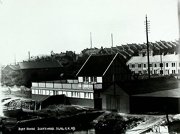
The first boathouse was opened at Low Elswick on Whit Tuesday, 17th May 1853, with a procession of the club's boats. The boathouse was capable of holding sixty boats and "was pronounced to be one of the most perfect in the kingdom". The new club had a successful first year, and won the University Plate at Durham Regatta. The following year it organised the Great North-of-England Regatta over a 14-mile course from Scotswood Bridge to Benwell Fishery. The Club records proudly state that it won the senior fours event, but newspaper reports reveal that the win was not as great as it might seem since the club supplied all four of the competing crews.
One hundred years ago in 1861, the Grand Challege Cup at Durham Regatta was won for the first time, the losing finalists being Durham Amateur Rowing Club which was then in its first year; the Grand Challenge Cup had replaced the University Plate as the senior trophy at Durham in 1854. Also in 1861, the Naworth Challenge Cup at Talkin Tarn Regatta was won outright, having been won in two successive years. James Wallace, one of -the originators of the clubs great sculling tradition, was a sculler of national status, and came third in the Wingfield Sculls (the Amateur Championship of England) in 1863. During this period, both amateur and professional rowing seems to have attracted much public interest since "nightly large groups of admirers of this noble sport witness trials at the Tyne Amateur Rowing Club and Clasper's Boathouses".
Little is known of the club's history during the following thirty years, apart from its continuing to win events at local regattas and venturing abroad to win at Hamburg in 1870. In 1891, however, it started the rowing season with only three oarsmen and was on the verge of closing, but additional oarsmen were found and several events were won. The general popularity of rowing seems to have declined at this period, since the Newcastle Chronicle remarked that "to those who remember the palmy days of sculling on the Tyne, it appears somewhat difficult to realise the decadence which has taken place in this most healthy exercise within recent years".
The eclipse of the club was short-lived since only two years later the Elswick boathouse was found unsatisfactory and a new building was erected at Scotswood Bridge,, The boathouse cost £350 and contained "the latest appliances for shower baths". Its opening on 15th July, 1893 was celebrated by rowing the first eight-oared race to be held on the Tyne. The race, between the Nomads, Ryton, South Shields and Tyne Amateur Rowing Clubs, was won by the home club. Lt. Col. James Wallace, who was a member of the club from 1859 until the first World War and was a Vice-President for many years, presided at the opening and said that the race was intended to inaugurate a movement to establish eights' racing on the Tyne.
The club continued to be very active, and shared in the general resurgence of the interest in rowing. In 1910 it was "becoming plainer day by day that there is a revival of interest in boat rowing on the Tyne'. In that year, Mr.Joseph Cowen, the proprietor of the Newcastle Chronicle, came upon the "Newcastle Chronicle Challenge Cup", which had been presented for the professional sculling championship of England in 1877, but won outright by J.Higgins the following year. Mr.Cowen presented the cup to the Tyne Amateur Rowing Club, and the "Joseph Cowen Challenge Cup" is now the premier trophy at the club's annual "At Home "Regatta.
Rowing was in abeyance during the 1914-18 war, but the Club affairs were looked after by the Secretary, Frank Kirby, and the boathouse was re-opened in April, 1919. The next ten years were very successful, under the captaincy and coaching of Magnus Mail who died in 1960 after 58 years with the Club. The senior four crews from 1922 -to 1926, in which Brian Brown, Rex Lowry. Alan Robson and Alex Thompson often rowed, were consistently successful, and Alan Robson was virtually unbeatable in senior sculling races. Wins during the 1930s were more spasmodic but 1935 and 1938 were particularly good years and Dick Thorp was successfully upholding the club's strong sculling tradition.
Activities were again stopped by a world war, but were restarted in 1946, under the captaincy of Alan Anderson. The first two or three years saw several major wins, mainly by oarsmen who had rowed before the war, but when these retired the club had to build up its strength again and for a few years was not so successful. The sculling traditions were maintained however, this time by Alan Beveridge who represented the Club at Henley Royal Regatta.
Members celebrated 100 years of the Clubs existence with a dinner on 16th December, 1952, the anniversary of the inaugural meeting. The President, Viscount Runciman, who had rowed in successful club crews in the 1920s, was in the chair. The centenary celebrations were continued with regattas held during the 1953 rowing season, and included the Club's first entry in the 4 1/4-mile Head-of-the-River Race rowed over the Boat Race course on the Thames.
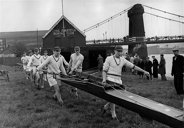
The Scotswood Boathouse was now almost beyond repair and as early as 1938 alternative sites for a new building at Scotswood and Newburn were being considered. The question was further discussed after the war and in 1952 the Newburn site was approved. Land was purchased just upstream of Newburn Bridge and work started in 1955, The clubs third boathouse was opened on the 6th April, 1957, by Viscount Runciman. The 1853 celebrations were re-enacted when, before the opening, the club's boats - an. eight, fours, and sculling boats - were rowed in procession from Scotswood.
Although much of the members' effort had been devoted to the new building, rowing had been carried on with moderate success. The brunt of organising the building of the new boathouse and the move from Scotswood had fallen on Jim Nisbet, who was Captain from 1954 to 1959, but he had at the same time laid some solid rowing foundations and cups were regularly won by the less experienced oarsmen and by scullers. His successor, Maurice Jackson, continued his work, and in 1960 senior fours from the club won eight events including the Palmer Grand Challenge Cup at Tyne Regatta. 1960 saw the first year of a league championship between the twenty-four clubs of the North-Eastern Division of the Amateur Rowing Association, and because of these wins and the consistent rowing of other crews, the club was the first to win the League pennant. 1961 was even more successful, when eighteen events were won. The club's record since then has been good, and the League pennant has been won every year.
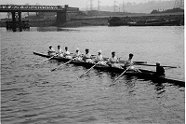
Club eights now regularly take part with 300 others in the 4 1/4 mile Mortlake-to-Putney Head-of-the-River Race which is rowed every March at the end of the winter's training. For the last six years, two crews and their boats have travelled to London for several days practice on the Thames before the race. The summer rowing season starts in April, and there is a regatta almost every week until mid-August. At the club's "At Home" Regatta in early June, rowed over a straight mile course from Stella to Newburn, the senior fours event for the Joseph Cowen Cup is rowed on a repechage basis with four crews abreast. Although this form of racing has been used in Olympic and other international rowing for some years, the Newburn Club was the first, in 1957, to introduce it to an English regatta.
The club also holds its private regatta every year at which the main racing is for two sculling trophies. The Chipchase Cup was presented in 1876 by the Messrs Taylor of Chipchase Castle, and only previous winners are debarred from competing; the Colombo Cup a beautiful carved silver bowl standing on ivory elephants was presented in 1922 by "Three Old Tyne Men in the East" and is contested by club members who have never won a sculling event.
The Tyne Amateur Rowing Club is probably more healthy now than it has ever been in its 112 years. Membership is increasing, but new members are always very welcome at Newburn, whether they have rowed previously or not.
Crews are now in training for the Head-of-the-River Race next Spring, and hopes for continued success in the coming seasons are high,
October, 1964.
TYNE AMATEUR ROWING CLUB DINNER
Tuesday last having been fixed as the formal closing day of the season, the usual dinner took place in the evening, at the Assembly Rooms, Newcastle, and was provided and served by Messrs. Brinton and Son, in their usual sumptuous-style. Upwards of forty members and other friends sat down to the repast.
In the unavailable absence of the president (M. L. Jobling, Esq.), the chair was filled by Mr. R. T. Fothergill : Mr. John Mills, jun., the hon. Secretary and treasurer of the club, occupying the vice-chair. Great interest was attached to the proceedings from the fact that the club, in order to show their appreciation of the efforts, on the part of the Tyneside watermen, to maintain the superiority of their river, had invited the celebrated Harry Clasper and his champion crew, one of whom is the renowned Chambers, who so lately won for himself the proud distinction of Champion Sculler of England. After the usual loyal and patriotic toasts had been drunk,
The CHAIRMAN rose to propose the toast of the evening viz., “The Tyne Amateur Rowing Club,” and in an able speech, reviewed the progress of the society, and descanted at some length on the exertions made by old members to place the club in the position it now occupies ; and he urged the new members to combine with spirit and follow the good examples shown them, in order not only to keep good the present position of the club, but to advance it, so as to be second to none in the kingdom.
The toast was drunk with great enthusiasm.
The next toast (from the chair) was the chi patron of the club “ His Grace the Duke of Northumberland.” who is also a subscribing member. Eloquently proposed, and received with rounds of applause.
Mr T. J. PICKETT, the captain of the club, next proposed the health of the president, M. L. Jobling, Esq., which was duly honoured, and great regret was expressed for his absence.
After the health of the vice-presidents, Messrs. Thomas H. Burnett and Jonathan Burnett had been drunk,
The CHAIRMAN rose to introduce perhaps the most interesting feature of the evening’s proceedings, and in an eloquent speech presented, in the name of the members, a handsome gold watch to Mr. Septimus Bell, their much-respected ex-Secretary and Treasurer, as a token of their appreciation of his services, and their respect for him as a gentleman.
Mr BELL, in a feeling speech, replied, and in thanking his brother members for the unexpected honour they had conferred upon him, assured them that all the services he had given to the club during his time of office had been done with the greatest possible pleasure to himself, and he was glad to find to the advancement of the club. Nothing should have prompted him to retire from the office when he did, but the necessity of his closer attention to his professional duties, which had become more onerous. He would treasure the handsome present they now made him, and it would always serve to remind him of the many happy days he had spent with his brother members of the Tyne Amateur Rowing Club.
The health of the Officers and Committee, associated with the name of Mr. John Mills, jun., the Hon. Secretary and Treasurer of the Club, was next proposed in a highly eulogistic speech by Mr. Wm. PEARSON, and received with nautical honours.
Mr MILLS responded in a neat speech, and on thanking them for the honour paid his brother officers and himself, expressed the great pleasure he took in discharging the duties of his office, and in advancing, by every means in his power, the noble and his favourite exercise of rowing. He hoped he would long be able to continue in his present position, and retain the respect and confidence of his brother members, and so long would he do all in his power to advance the interests and position of the Club.
Mr. SEPTIMUS BELL, in a happy speech, proposed the health of Chambers, the champion, and also of the veteran Harry Clasper, and the remainder of the champion four, which was received with vociferous applause.
Mr. R. CHAMBERS responded in a characteristic and manly speech ; and in thanking them for the honour they had done him, he said he felt great pride at being invited to the banquet of the Tyne Gentlemen Amateur Rowers, but more particularly at being able to appear before them as champion, which title he should maintain as long as his powers would enable him to contest for it. He concluded by wishing success and continued prosperity to the Tyne Amateur Rowing Club, and expressed the pleasure he would have in rendering the members any assistance in his power to advance them in the art of rowing.
The veteran HARRY CLASPER next responded on behalf of himself and crew, and expressed the great gratification he felt at being invited to dine with the club, many of whom he had so long known as supporters of aquatic sports. He expressed the pride he felt at having “beaten the field” for the champion four oar race at the late Thames National Regatta ; and he expressed the pleasure it would afford himself or his son in being of any service to the club, which, he was sure, was possessed of the requisite stamina that, if properly developed, would enable them to meet any crew which might be brought against them. He resumed his seat amidst loud cheers.
Mr. J. H. CLASPER, son of the above, and bow oarsman of the champion four, and Mr. WINSHIP, the other member of the crew, each returned their thanks in a few appropriate remarks.
Mr. R. P. HARDCASTLE proposed the “Winners of the Season,” coupling with it the name of their indefatigable captain, Mr. Tom J. Pickett, who had added considerably to his laurels during the season. The toast was received with much enthusiasm.
Mr. PICKETT, in responding, said he felt it a great honour to be again toasted as a winner ; and if he had not the power of a Chambers, he was proud to say he had the will ; had he the power he would not feel satisfied until he was amateur champion of England. He then strongly urged upon the members the necessity of close training, and said that with such advantages as they possessed in having such a river to row upon, such first-class boats for practising, and, finally, the opportunity of witnessing and benefiting from the style of the champion sculler and oarsmen of the world ( all Tyne men) he felt convinced, from his own experience of amateur rowing clubs, that there was material in the T.A.R.C., which, if properly trained, could contend with credit against any amateur rowing club in the kingdom. He hoped that next season would produce fresh aspirants for aquatic honours.
Other toasts, including “The Ladies,” “The Strangers,” &c, were proposed and duly honoured, and the remainder of the evening was spent in a humorous and pleasant manner.
Transcribed by Brian Dalkin from a newspaper cutting provided by David Clasper, August 2017.